What does "Learning" mean in the age of Artifical Intelligence?

Knowledge may be a prompt away. Mastery still has to be earned.

A managed learning environment built on more than twenty years of educational technology, diagnostic assessment, guided remediation and human teaching.

Established through practice

Educational technology has changed repeatedly over the last 200 years. The hard, effortful work associated with "learning (mastery)" has not.

XVC did not start with the arrival of artificial intelligence.

Its foundations were developed through more than two decades of tutoring, video-memorandums of typical questions, e-Learning, Moodle course design, e-Assessments, learner support and direct work with families.

Artificial intelligence now extends that work. It does not replace the pedagogy, discipline, human judgement or learner effort on which real progress depends.

The XVC Gold Standard:

Access to knowledge is not the same as mastery.

Books, videos, tutors, online courses and AI can all provide information. XVC is concerned with what happens after that access has been provided - what does MASTERY look like?

Information can be supplied.

A learner can receive an explanation, watch a memorandum, search for an answer or ask an AI system for help.
There was a time before artifical intelligence when the ability to recall facts and knowledge from memory was a sought-after skill. But now all the information in the world is just a prompt away....what does that tell us about the line between "knowledge" and "learning"?

Capability must be developed.

The learner must still understand, attempt, correct, practise, verify and eventually use the knowledge without dependence on the source. That is when we know that mastery has taken place. And in the age of AI this is the one thing to look out for: Is knowledge and information just regurgitated, or was it mastered?

The XVC Teaching Ecosystem

A managed route from uncertainty to capability.

The components of the Virtual Campus are connected deliberately. Each has a defined role in diagnosing, interpreting and addressing a learning need.

01

Assess

Diagnostic and formative assessments establish what the learner can currently do and where further attention may be required.

02

Interpret

Question-level reports place an answer in context by identifying the relevant concept, background knowledge and likely misconception.

03

Remediate

Educator-designed pathways connect the learner to SOTS Prompts, the Over-the-Shoulder AI Tutor, video memorandums, focused practice and other suitable resources.

04

Support

The Human Tutor Fallback (HTF) and direct assistance remain available when technology or an existing resource is not sufficient.

05

Practise and reassess

The learner returns to the work, applies what has been learned and provides evidence of growing independence and mastery.

06

Make participation visible

Where appropriate and consented to, engagement reporting helps authorised adults (i.e. Teachers) see whether the available learning process is actually being used.

The original implementation of this model can be viewed through the established XVC Teaching Ecosystem for Mathematics.

Learn more about the XVC Teaching Ecosystem

Experience the architecture

Three points of entry.

Visitors may begin with a diagnostic process-demp, or create the required learning profile or enter the guided tutoring environment. The exact architecture depends on the design of individual Pedagogical Engineers.

Moodle learning profile

Moodle provides access to assessments, activities, reports and participating Pedagogical Engineers' Channel learning routes.

Create a Moodle profile

Over-the-Shoulder AI Tutor

A guided environment for working through questions, examining attempts and progressing one step at a time.

Open the AI Tutor

Pedagogical Engineer Channels

Educator-led teaching spaces within the Virtual Campus.

Each Channel applies the XVC architecture through the subject knowledge, pedagogy and professional judgement of its educator (the Pedagogical Engineer).

Channels may include diagnostic tests, SOTS Prompts, XVC Pocket Practice, video support, question banks, human tutor fallback, once-off resources and longer learning programmes. Each educator determines the appropriate combination for the learners they serve.

Enter the various Channels of the Pedagogical Engineers

Over-the-Shoulder AI Tutor

AI in the service of pedagogy.

The Over-the-Shoulder AI Tutor is not presented as a substitute for teaching. It extends careful questioning and guided explanation into the learner’s work with pedagogically designed human interactions.

When a learner reaches the point where a question must be worked through rather than merely looked up: "OTS it".

Visit the Over-the-Shoulder AI Tutor
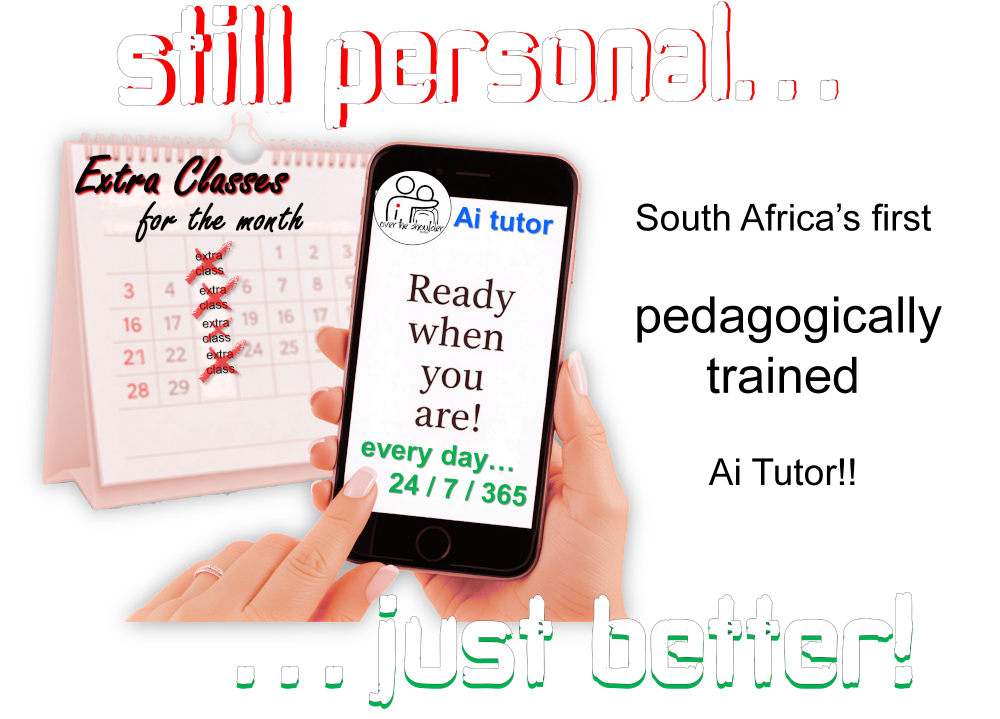
A calendar of fixed extra classes contrasted with the Over-the-Shoulder AI Tutor, available every day throughout the year.
Personal guidance is not discarded. The Over-the-Shoulder AI Tutor extends its availability beyond mere prompts by students.

One step at a time

The learner is guided through manageable decisions rather than being given an immediate solution dump. We call these "Decision Gates".

The learner remains active

Attempts, explanations, verification, feedback, learning style recognition, "pushback" questions and guidance remain part of the process.

Educator-guided pathways

SOTS Prompts allow Pedagogical Engineers to bring their own sequencing, checks and teaching logic into the conversation, while allowing the Over-the-Shoulder Tutor to operate with the power of AI in between those guardrails.

Human intervention and guardrails remain

Technology extends the educator to a sphere where the physical constraints of time or geography do not allow the Educator to be present; but it does not remove the need for judgement or direct design.

No learning system can succeed when the learner does not participate.
The Pedagogical Engineers make the learning routes clear, participation visible and support available.

Mastery, however, still requires action.

This principle applies equally to learners, educators and the adults responsible for supporting the learning process.

Over the Shoulder media

Education, technology and the realities of learning.

The Over the Shoulder YouTube channel hosts conversations and practical content about teaching, educational technology, AI-supported learning and the work that remains necessary inside real classrooms and homes.
We also host tutorial videos on how to use the AI Tutor for best results.

Visit the YouTube channel

For educators

Become a Pedagogical Engineer.

Educators contribute subject knowledge, misconceptions, sequencing, explanations and methods of checking mastery. Internet Learning Solutions (Pty) Ltd converts that pedagogy into practical digital learning assets and channel structures.

Read the full educator introduction

Human support

Speak to a real human.

Contact us for assistance with registration, diagnostic test access, PE Channels, the appropriate next learning route or for any questions you may have.

Chat with a real human on WhatsApp